The Bias Against Guns by John R. Lott Jr
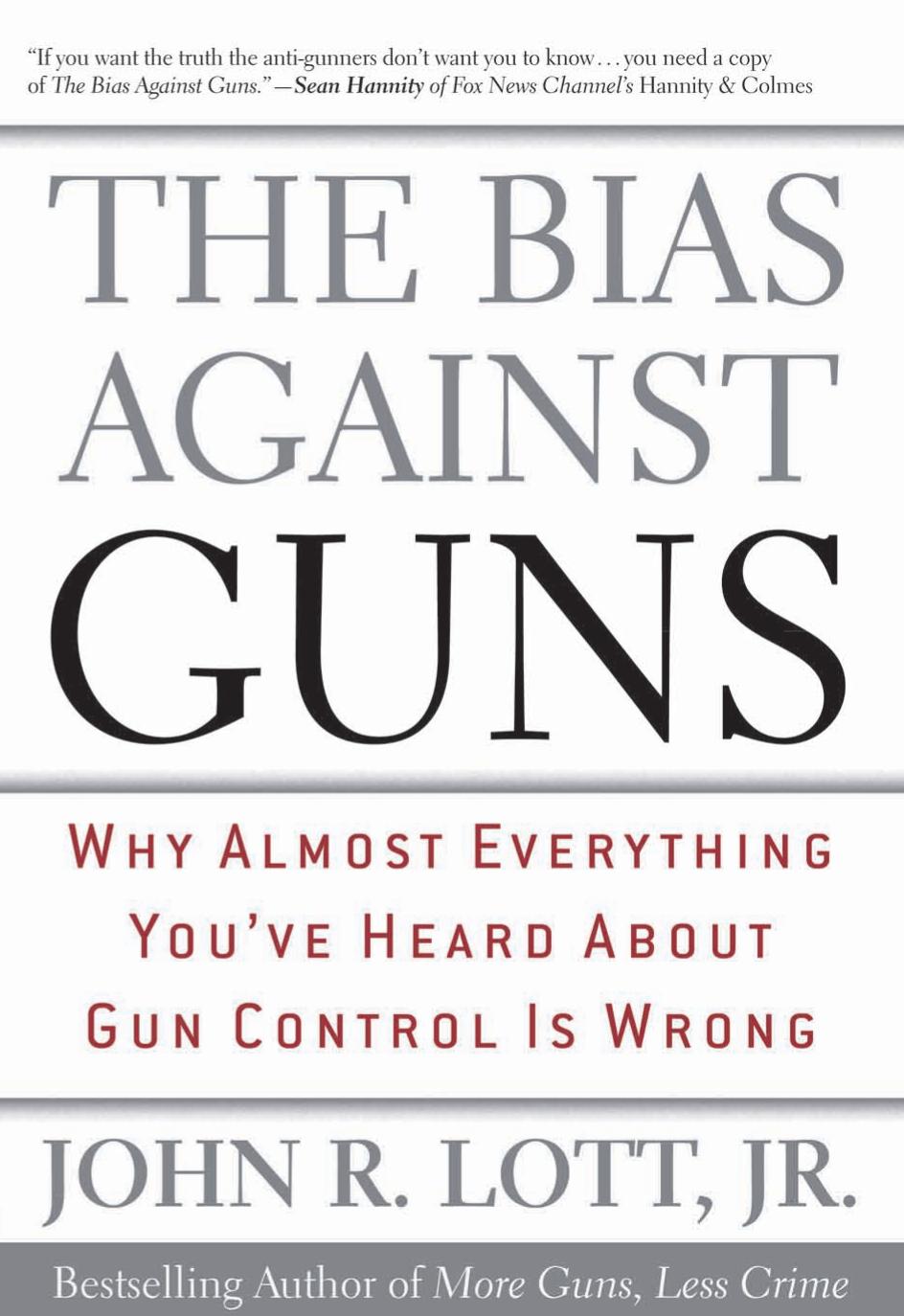
Author:John R. Lott Jr.
Language: eng
Format: epub, pdf
Published: 2014-05-08T18:40:59+00:00
BiasAgainstGuns 191-226.qxd 10/9/07 1:34 PM Page 191
C H A P T E R 8
DO GUN SHOWS AND ASSAULT
WEAPONS INCREASE CRIME?
[Senator Joseph] Lieberman’s beef with the gun lobby is that
the distinct lack of background checks at gun shows provides
terrorists (and anyone else for that matter) with a perfectly
legal means for purchasing weapons, including assault rifles
and hand grenades.
Peter Wendel, “After 9/11: Got Big Chutzpah?”
Campaigns & Elections , February 2002
. . . [S]tates that do not require criminal background checks at gun shows are flooding the nation with crime guns.
Jim Kessler, Policy and Research Director
at Americans for Gun Safety 1
Why would a guy who doesn’t want to be identified as a felon
or a potential criminal show up at a gun show and buy a
weapon in public when he could go buy it in—in some seedy
hotel somewhere out of a suitcase? Why would he do that?
Chris Matthews, CNBC’s Hardball , June 19, 2001 2
I. INTRODUCTION
Labels are important. Labeling something a “loophole” in a gun law almost automatically generates a desire to “close” it, whatever it is.
“Assault weapons” conjure up images of machine guns. As the Wendel 191
BiasAgainstGuns 191-226.qxd 10/9/07 1:34 PM Page 192
192
The Bias Against Guns
quote indicates, to many people these issues are tied together. While many are concerned about gun shows or assault weapons and crime, since September 11 these fears have been further magnified as concerns rise that terrorists are acquiring weapons to use against Americans.
Gun shows are frequently described as places where grenades and other bombs are sold and as an inappropriate “carnival atmosphere” associated with weapons.3 Both their defenders and detractors view gun shows as opportunities for the pro-gun culture to solidify its base, in that gun shows provide a meeting place for people with similar interests and a way for them to learn about guns.
Polls suggest strong support both for closing the gun show “loophole” (that is, mandating background checks on the private transfer of guns at gun shows) and the assault weapons ban (a ban on certain semi-automatic weapons based either upon cosmetic features or
merely their names). In early 2001, Opinion Research Corporation International found 82 percent of people support closing the loophole.4
An NBC News poll indicated that over 70 percent of people wanted the assault weapons ban to remain in place.5 In 2000, gun show regulation initiatives passed comfortably in Colorado and Oregon.
As discussed in Chapter 4, the notion of a gun show “loophole” is questionable simply because there are no different rules for buying a gun in a gun show than anywhere else.6 Gun control groups, such as Americans for Gun Safety, identify eighteen states that have closed the
“loophole,” but interestingly, prior to 2000, only three of these had laws that even mentioned gun shows. What usually constitutes closing the loophole are laws that require background checks for private transfers of handguns. Since 1994, federal law has required background checks for all handguns purchased through dealers. The checks were extended to long guns in 1998. But regulating transfers by private individuals—such as those at gun shows—has been left to the states.
Download
This site does not store any files on its server. We only index and link to content provided by other sites. Please contact the content providers to delete copyright contents if any and email us, we'll remove relevant links or contents immediately.
The Vikings: Conquering England, France, and Ireland by Wernick Robert(84229)
Ali Pasha, Lion of Ioannina by Eugenia Russell & Eugenia Russell(40256)
The Conquerors (The Winning of America Series Book 3) by Eckert Allan W(37473)
The Vikings: Discoverers of a New World by Wernick Robert(36978)
Cecilia; Or, Memoirs of an Heiress — Volume 1 by Fanny Burney(32558)
Cecilia; Or, Memoirs of an Heiress — Volume 2 by Fanny Burney(31956)
Cecilia; Or, Memoirs of an Heiress — Volume 3 by Fanny Burney(31942)
Empire of the Sikhs by Patwant Singh(23086)
The Secret History by Donna Tartt(19088)
Hans Sturm: A Soldier's Odyssey on the Eastern Front by Gordon Williamson(18592)
Cat's cradle by Kurt Vonnegut(15355)
Pimp by Iceberg Slim(14507)
Sapiens: A Brief History of Humankind by Yuval Noah Harari(14389)
Talking to Strangers by Malcolm Gladwell(13370)
Norse Mythology by Gaiman Neil(13365)
Leonardo da Vinci by Walter Isaacson(13336)
4 3 2 1: A Novel by Paul Auster(12392)
Underground: A Human History of the Worlds Beneath Our Feet by Will Hunt(12098)
The Radium Girls by Kate Moore(12028)
